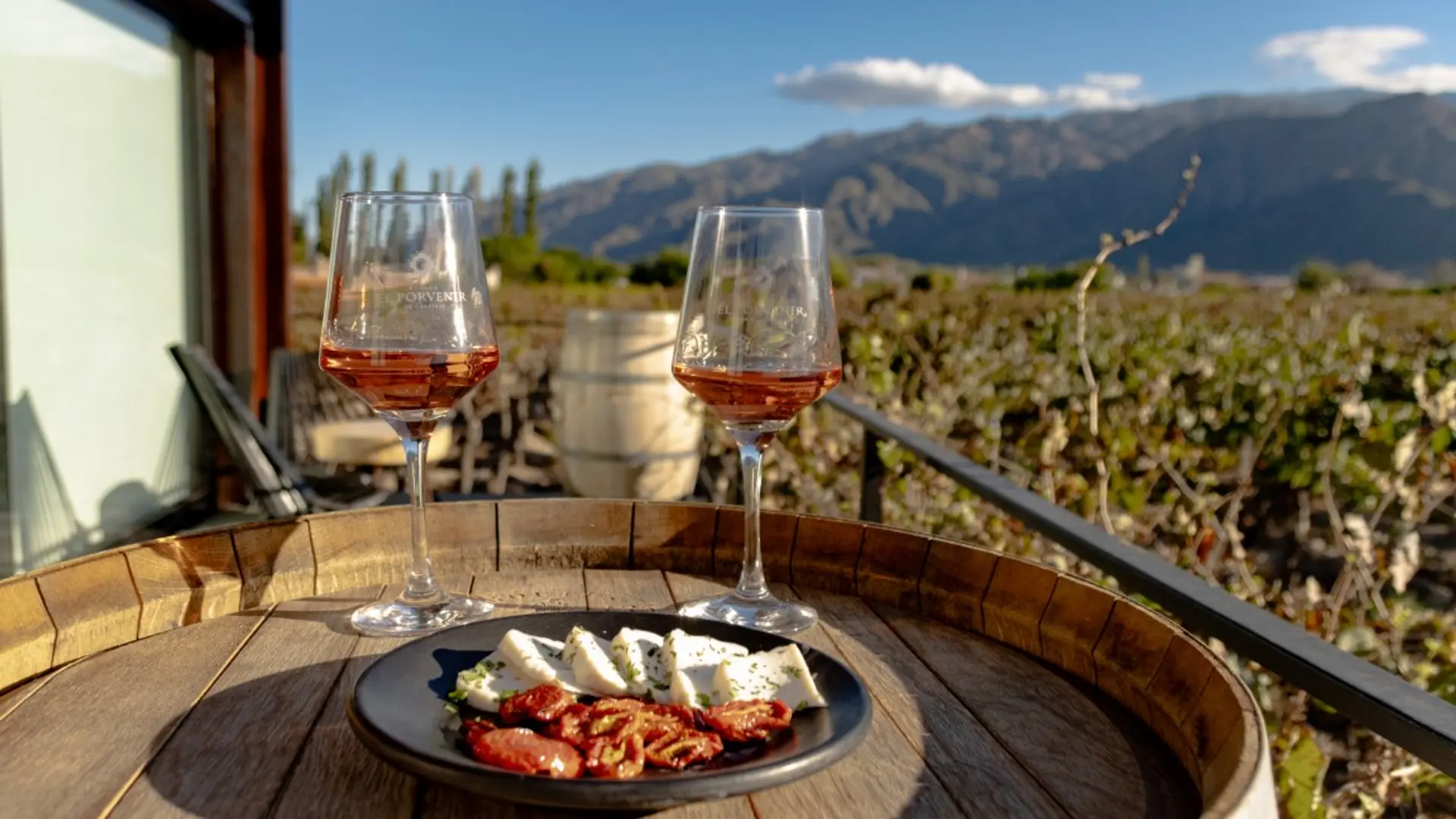
The Calchaquí Valleys stretch over 270 kilometers across northwest Argentina, home to some of the highest vineyards on the planet. In this region, altitude is not a detail — it is the foundation of everything. The vine would have no place at this latitude near the Tropic of Capricorn were it not for the elevation, which ranges from 1,700 meters in Cafayate, province of Salta, to over 3,500 meters in the most extreme parcels of the Quebrada de Humahuaca, in the province of Jujuy. This altitude compresses temperatures, intensifies solar radiation, and preserves natural acidity in a way no other Argentine wine region can replicate.
Unlike Mendoza, with its more uniform landscapes and internationally oriented gastronomy, northern Argentina presents a dramatic and diverse geography, a cuisine deeply rooted in Andean traditions, and a more heterogeneous cultural identity where indigenous and colonial influences coexist visibly.
For wine professionals, sommeliers and advanced enthusiasts, the Calchaquí Valleys stand today on par with Valle de Uco as one of Argentina's most compelling wine destinations and one of the most complete wine tourism experiences in all of South America.
Why altitude changes everything
Temperature and elevation. For every 150 meters of ascent, the average temperature drops by approximately one degree Celsius. At 1,700 meters, Cafayate produces wines with a character comparable to southern Spain; at 2,600 meters in the town of Cachi, the climate resembles that of Champagne. The same sun, radically different growing conditions.
UV radiation and light intensity. The thin high-altitude atmosphere filters little ultraviolet radiation. In response, grape skins develop greater thickness and higher concentrations of polyphenols, producing deep colors, intense aromas, and the structural complexity that distinguishes these wines in international tastings.
Diurnal temperature range. The difference between daytime and nighttime temperatures is extreme. This thermal cycle slows vine metabolism and preserves the grape's natural acidity, giving rise to wines with freshness, definition, and aging potential.
From indigenous heritage to the international avant-garde
The Calchaquí Valleys offer one of Argentina's most diverse varietal portfolios, shaped by altitude as much as by centuries of winemaking history.
Torrontés Riojano is the region's signature white variety: aromatic, with notes of jasmine, rose and citrus, and achieving its finest expression right here. It is a pre-phylloxera variety of colonial origin, exclusive to Argentina. High-altitude Malbec loses weight and gains precision. Cabernet Sauvignon develops an unmistakable profile of dark fruit and roasted pepper. Merlot from Cachi has attracted international critical attention for its freshness at extreme altitude. Tannat and Syrah complete a varietal mosaic in constant evolution.
Key destinations along the Northern Argentine Wine Route
Cafayate — 1,700 m a.s.l.
The commercial center of the region and its greatest concentration of wineries. Historic estates such as El Esteco (founded in 1892) and Piattelli operate here, alongside more recently established boutique producers. The town itself — colonial architecture, artisan markets, a central square lined with wine bars — deserves time of its own. The surrounding landscapes, particularly the magnificence of the Quebrada de las Conchas, are among the most photographed in northwest Argentina.
Cachi — 2,600 m a.s.l.
A more remote destination north of Cafayate, set at the foot of the Nevado de Cachi (6,300 meters, with snow-capped peaks for much of the year). The vineyards are younger, but a group of producers is achieving wines of remarkable precision, particularly Merlot and Malbec, in granitic soils at extreme altitude.
Molinos — 2,200 m a.s.l.
Between Cafayate and Cachi, the valley narrows and the road climbs through one of the most striking landscapes in the Argentine Andes. Here lies Hacienda Tacuil, one of the few wine estates in the world with an unbroken history dating back to the colonial era. Wines from this intermediate elevation tend toward power, with a mineral and earthy character that clearly sets them apart from Cafayate or Cachi.
Salta City — 1,150 m a.s.l.
The natural starting point for any visit to the region. Two days in Salta allow visitors to explore the Museum of High-Altitude Archaeology, which houses Inca mummies found on nearby Andean summits, and to experience a traditional peña — evenings of Andean folk music that are as much a part of the northwest's cultural identity as the wine itself.
Quebrada de Humahuaca — 2,000–3,500 m a.s.l.
A cultural and scenic corridor stretching over 150 km in the province of Jujuy, recognized by UNESCO as a World Heritage Site in 2003 for its historical and natural value. Along the gorge, a succession of towns with strong Andean identity blend pre-Hispanic and colonial traditions. The multicolored terrain, featuring landmarks like the Hill of Seven Colors and the traces of the ancient Inca Trail, forms one of the most distinctive cultural landscapes in northern Argentina. Varieties such as Malbec, Syrah, Cabernet Sauvignon, Torrontés and some Criolla grapes have been cultivated with outstanding results in recent years.
History and winemaking heritage
The soils of the Calchaquí Valleys hold a history that predates European viticulture by millennia. The farming terraces built by the Diaguita people, before the arrival of the Inca Empire in the 15th century and the Spanish in the 16th, are still visible among the rows of some estates. Viticulture was introduced by Jesuit missionaries in the 17th century, who brought vines from the Canary Islands via Chile. The result was a population of pre-phylloxera vines that survived intact the plague that devastated European vineyards in the 19th century, among them Torrontés Riojano.
International attention arrived in 1988, when French winemaker Michel Rolland was invited by Salta-based producer Arnaldo Etchart to work as a consultant. A decade later, Swiss investor Donald Hess acquired Bodega Colomé (Argentina's oldest winery) and developed his Altura Máxima vineyard at 3,111 meters above sea level. Colomé also houses the James Turrell Museum, a permanent installation purpose-built for the work of the American light artist, designed in dialogue with the distinctive quality of light at that altitude in the Andes.
Landscape, gastronomy and hospitality: a complete travel experience
Exploring northern Argentina is an experience that transcends wine. The routes connecting Salta, Cafayate, Cachi and the Quebrada de Humahuaca traverse some of the most striking landscapes on the continent: canyons of sedimentary rock in shades of red and ochre, salt flats of extreme scale, multicolored hills, cardón cacti exceeding ten meters in height, and colonial adobe villages set above 2,000 meters. These are journeys where the pace slows naturally, almost inevitably, in the face of the surrounding grandeur. That same contemplative disposition then accompanies travelers into the wineries, shaping a more attentive way of tasting, more connected to the place.
The region's tourism infrastructure has reached international standards without losing local authenticity. In the hospitality segment, the offering includes globally renowned properties: Grace Cafayate, with spa, residential villas and a golf course on over 500 hectares; Patios de Cafayate Wine Hotel, set in a historic 1892 building; Estancia Colomé, a benchmark for remote luxury accommodation in the Andes. For those seeking a singular experience, the Pristine Salinas Grandes Luxury Camp offers luxury glamping on the fourth-largest salt flat in South America, with signature cuisine and local staff.
Northwest Argentine gastronomy is a central part of the travel experience. Unlike Mendoza, where the dining scene tends to be more standardized and internationally oriented, the north is defined by a territorially rooted cuisine, more closely tied to Andean traditions and a less curated cultural identity. Regional cuisine — Salta-style empanadas, humitas, locro, tamales — combines Andean ingredients with colonial techniques and a deep sense of identity. In the city of Salta, the Paseo Güemes dining corridor brings together offerings that blend regional flavors with contemporary approaches. In the valleys, paired lunches at wineries, with wines from the estate's own parcels, are a regular part of the itinerary. The warmth and professionalism of Salta's hospitality completes an offering that positions northern Argentina among the most comprehensive wine tourism destinations in Latin America.
Follow me on Instagram to see the places and get more info about wine-related travel! @kalaparrax
You may also like
How to Plan a Wine Trip Across South America
Seasons, destinations and why a well-planned wine tourism trip transforms the experience. A practical guide to Argentina, Chile and Uruguay.
Read more →
The Geography of Chilean Wine: From the Pacific to the Andes
A strip of land between the ocean and the mountains with unmatched climatic diversity: how Chile's geography shapes its wines.
Read more →Want to live these stories?
We design educational itineraries for wine professionals and enthusiasts.
Let's talk about your trip